| |
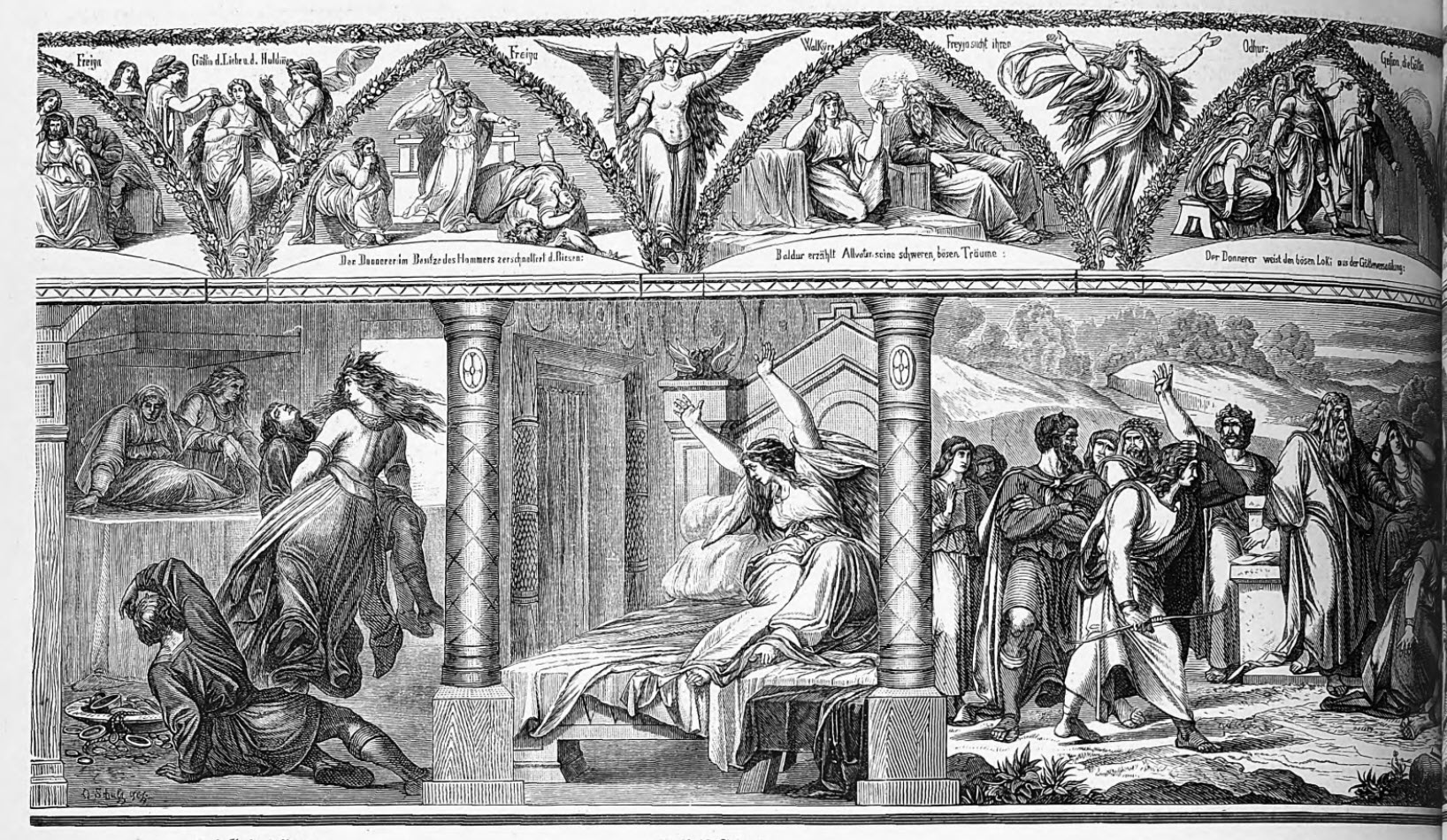
In the next
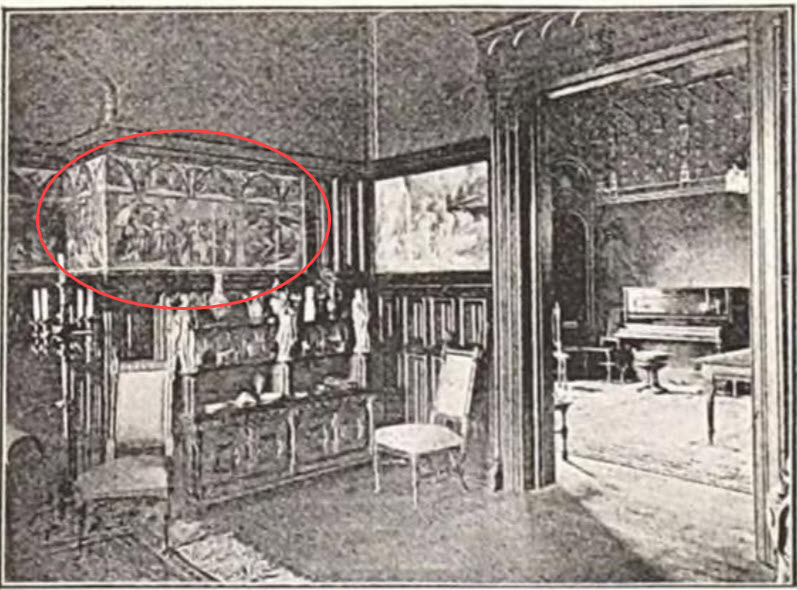
lunette, the Thundergod, dressed as a bride, retrieves his
hammer
and slays the Giants. Loki watchs on with indifference;
then Freyja the Valkyrie;
Baldur tells All-Father his Troubling Bad Dreams; Freyja in
search of Odur; Thor Drives Loki Out of Aegir's Feast. Next
spandrel (not visible in the page fold): Gefion the
Goddess of Innocence.
|
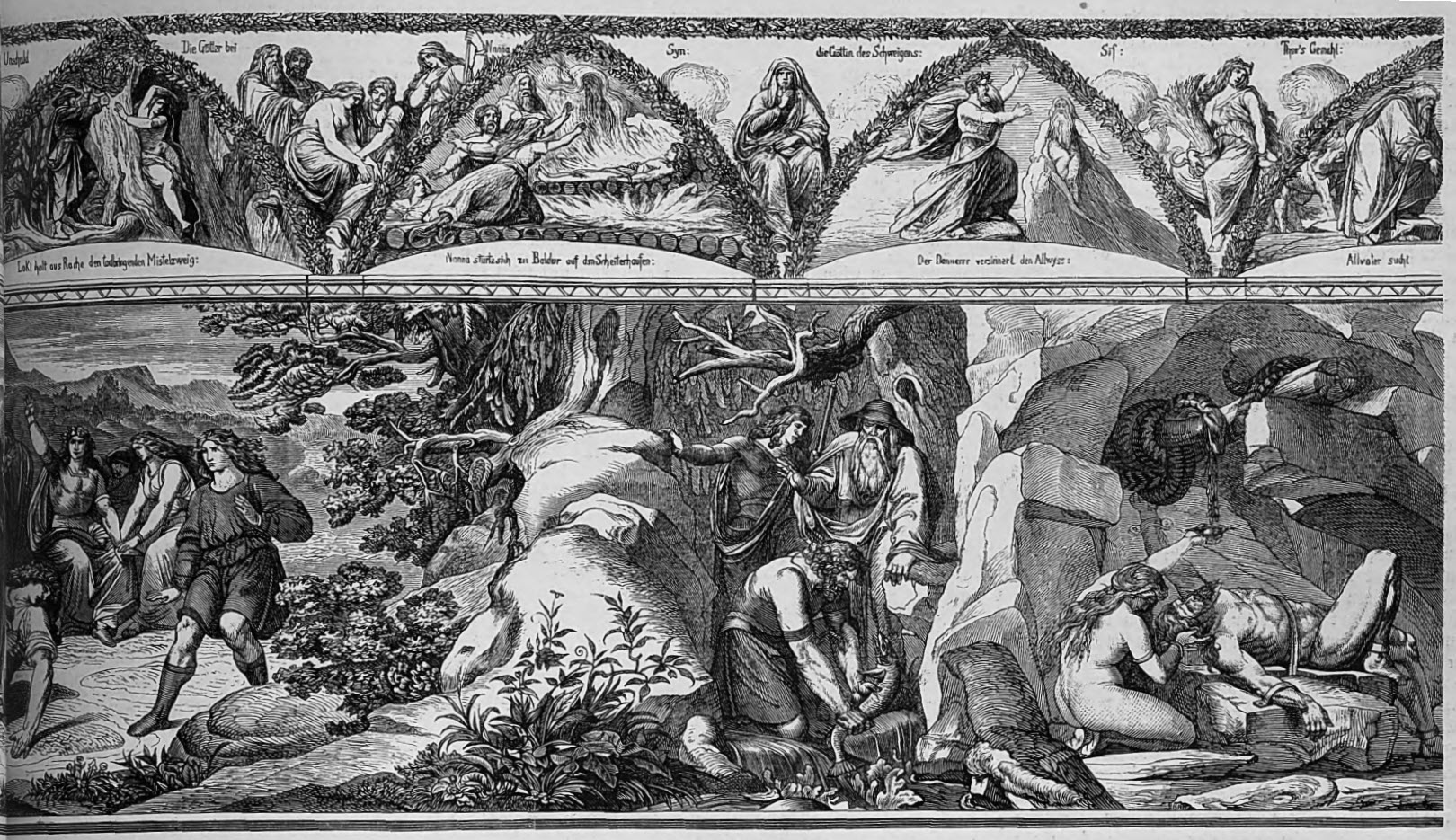
Next Lunette:
In revenge, Loki retrieves the deadly Mistletoe.
The Gods Comfort Nanna; Nanna Joins Baldur on the Pyre;
Syn, the Goddess of Silence;
Thor tests Allvis; Sif, Thor's Wife; All-Father
seeks Mimir's Counsel.
Split panel, scroll Right >>> |
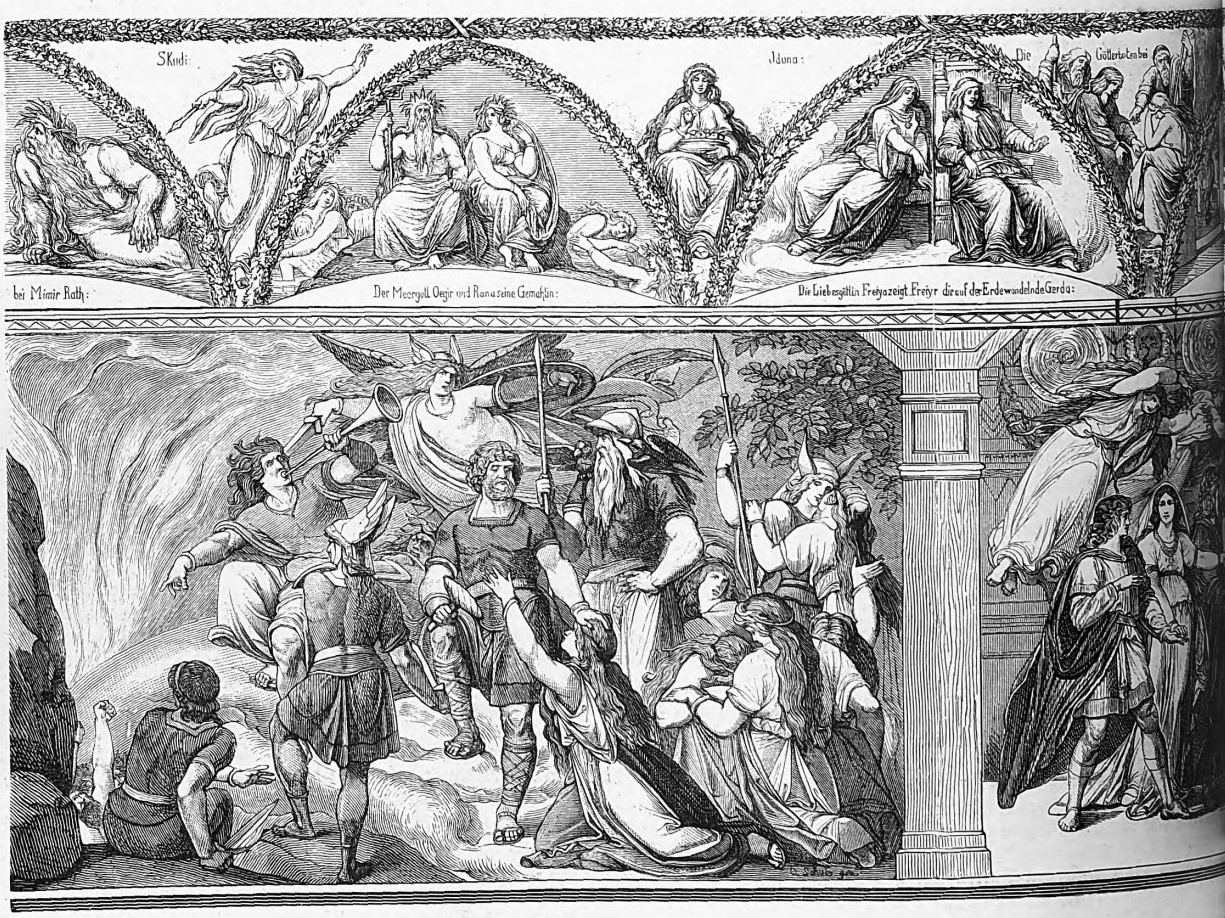
Then, in the next spandrel, Skadi; The
sea-god Aegir and
his wife Ran; Iduna; The Love-Goddess Freyja Shows Freyr
the mortal Gerda; Odin's Three Messengers comfort Iduna. In the
last lunette (not
visible, due to the page fold): Skirnir offers Gerd gifts
from
Freyr. A helmet on his head and a sword at
his left side, Skirnir offers the ring Draupnir with his
right hand, pointing away with his left. Gerda, with a handmaiden behind her, makes a
gesture of refusal. |
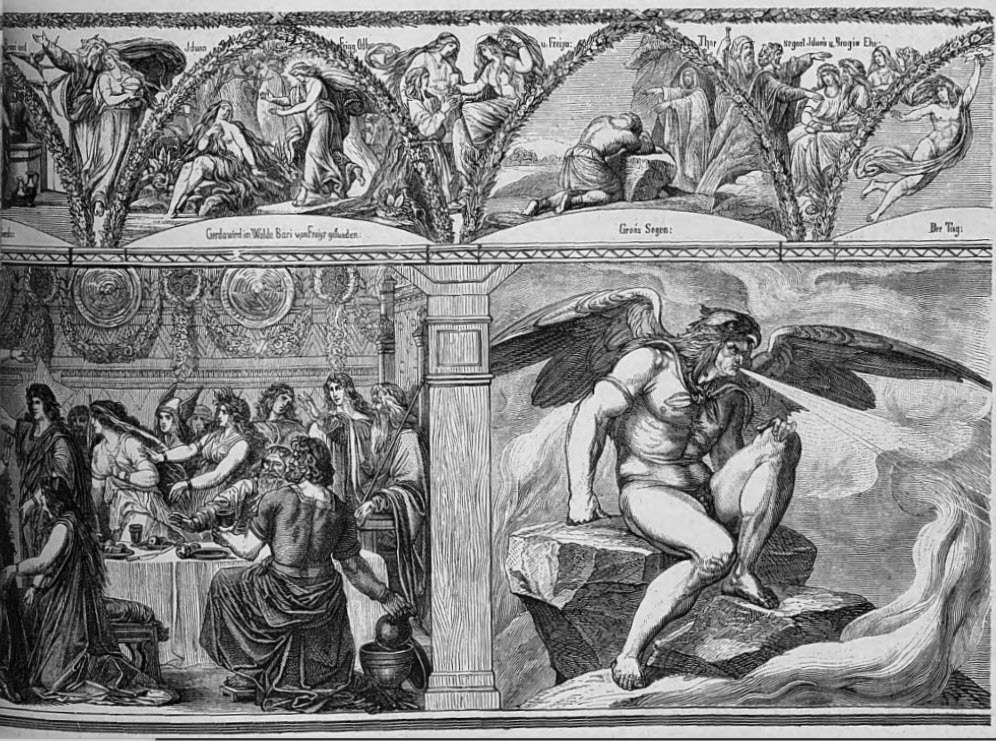
In the next spandrel, Bragi
and Iduna; Gerd Agrees to Meet Freyr in the Wood Barri;
Frigg, Odur and Freyja; Groa's Galder-song; Thor Blesses
Bragi and Iduna's Marriage; The Day (in the final
half lunette, at the End of the Cycle).
|
| |
IV. The Theft of the Gold.
The three Fate-sisters have brought the gods an evil
gift, the gold. Then Odur, the human who is among the
Æsir as Freyja’s husband, wishes to steal the sisters’
treasure and is incited to do so by Loki, the lover of
gold. Then his fate overtakes him: Skuld, the youngest
of the Norns, the Valkyrie, carries him off so that he
may atone for his misdeed; for he has sinned, since
through the theft he becomes unfaithful to the gods and
especially to Freyja, his wife.
V. Freyja’s Fright. Early in
the morning, when Freyja awakens, she finds her husband
Odur’s place empty, and the place that was rightfully
his untouched.
VI. Loki, the evil one,
plots further misdeeds. Once when the gods are gathered
together and, for amusement, shoot at Baldur — the
gentlest and best, the beloved of all gods and men — the
evil one goes to Hödur, the blind strong god, Baldur’s
brother, and hands him the mistletoe arrow, which he now
shoots at Baldur; the bowstring twangs, and the arrow
strikes the god fatally, for only by mistletoe could
Baldur be killed, since Baldur’s mother forgot to take
from it the oath of loyalty, that it would not harm her
beloved son.
Mortally wounded, Baldur falls to the ground, the arrow
in his heart. His wife Nanna collapses in agony over his
corpse. Frigg tears at her hair in horror. Gods and
goddesses lament, and Thor raises his hand threateningly
at Loki.
|
VI. (continued) To the left
of the page fold, Odin and Frigg, with hands on her
head, stand over the dying Baldur and his grieving wife
Nanna (in the page fold). To the right, the three Norns
look on. Verdandi raises her hand toward Loki who will
be soon be captured and bound; the identity of the
long-haired male figure on the right is unclear.
VII. The Evil One’s Capture.
Loki flees into a cave near a waterfall; there Heimdall,
Thor, and Allfather find him. Quickly he transforms
himself into a salmon and leaps into the waters; but
there stands a net of the gods. He jumps back. Thus he
comes just right for Thor; the latter seizes him firmly
and holds him despite his twisting and struggling.
VIII. The Evil One’s
Punishment. Loki is in the gods’ power; he must
transform himself back into the form of an Ás in order
to atone for his misdeeds. The venom‑dripping serpent is
hung above the bound one. Sigyn, Loki’s wife, sits
beside him and holds a bowl over his head so that the
venom does not strike her husband. But when she empties
it and the venom drips onto his face, the bound one
writhes in such pain that the earth quakes.
|
IX. The Expectation
of Battle. Because treachery has now spread among the
Aesir through gold, they too fall prey to the fate of
the Fates, and because they forgot the two wolves bound
by the old woman in the Ironwood, these wolves now come
and free Loki from his bonds. Now all misfortune is
unleashed, the last day dawns, the terrifying figures of
Hel prepare him for battle against the Aesir: this is
Ragnarök!
But the Aesir, too, await,
armed, silent, and solemn, the final, the most difficult
battle. Allfather, with his two ravens, stands, leaning
on his spear, behind Thor, who lays his hand on the head
of his lamenting husband, Sif, to comfort her. Heimdall,
seated on the Bifröst ("Bridge of the Gods"), hears the
black-and-red roar of the horn and blows his
Gjallarhorn. Freyja, as a Valkyrie, floats ahead to
battle; Tyr, the young war god, standing on the left in
the foreground, grips his sword tighter; beside him
stands the mighty Vidar, wolf-slayer. Freyr, the god of
light, bids farewell to Gerda, and Frigg, in whose womb
Gefion hides, sits calmly and composed beside the
passionately agitated Sif.
|
X. The Blessed Gods’
Reunion in Valhalla The battle is over. The evil
beings have fled, and once more the gods are in
Valhalla. Then Freyja enters, Odur at hand, who
has dearly atoned for his misdeed. Bragi, the god of
poetry, brings Iduna with the golden apples back to the
Aesir. As the first, Baldur receives a golden apple, a
rejuvenating gift from the goddess’s hand — at his
wife’s request. Freyr and Gerda, the all‑golden, greet
the approaching ones with great joy, as do Sif and
Vidar, who no longer remains silent, but shows Frigg
those who are entering; and also the kind All‑Father
upon Hlidskialf’s seat. Now the Aesir are once
again joyful and united, Idun and Bragi, the god of
poetry and the goddess of spring, have returned to them.
XI. The Wind. At the
end of the heavens sits a giant who, with blasts of
breath, fans the wind; with this depiction the Cycle
(Zyklus) comes to a close.
“Hræsvelg is he who sits at heaven’s end In eagle‑garb, a jötun (a
giant), with his pinions he drives the wind over all
peoples.” (Edda.)
|